
I have been saying some version of the same thing at conferences since tokenizing a real asset was a fringe panel topic nobody wanted the 4pm slot for.
So a month ago I decided to try and break it.
The plan was simple. Draw the entire lifecycle of a real-world asset going on-chain, end to end, every single step, and find the part that does not exist yet. Everyone in this category is hunting for that part. Usually they think it is an exchange. Some venue where tokenized assets will finally trade properly, and once somebody builds it the whole thing unlocks.
I thought I knew roughly where the hole was. I wanted to see it drawn.
What we actually did
Not a category diagram. Those are everywhere and they are useless, because they group things by what they are called instead of by what has to happen.
We walked the actual sequence. A loan gets written. Somebody has to value the thing behind it. Somebody has to issue it, keep the register, hold the keys, price it, finance it, move it, service it, and eventually let an institution post it as margin against a derivative at two in the morning in another jurisdiction.
Every one of those is a separate job, and almost every one is a separate company.
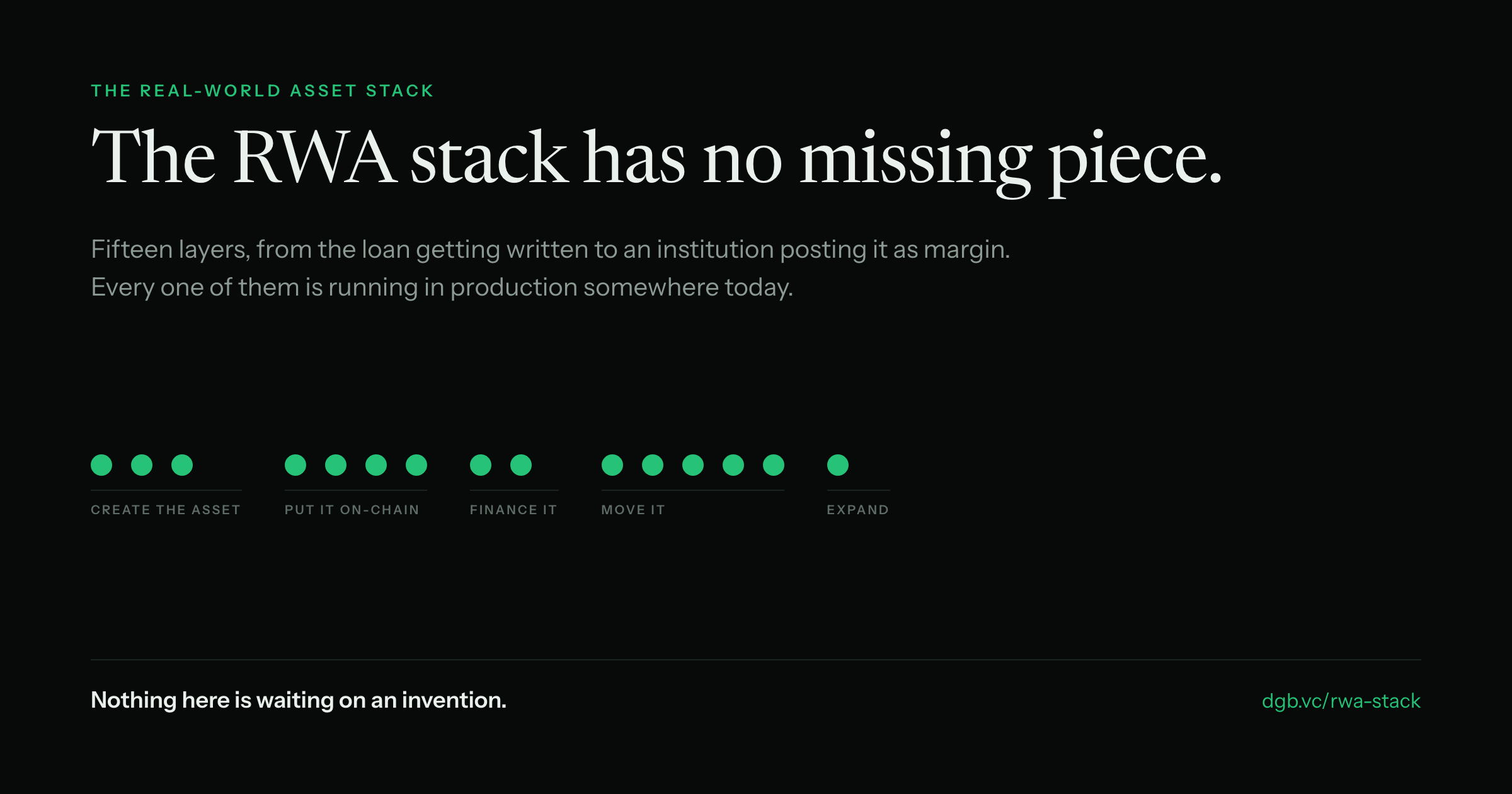
It came out to fifteen layers.

Then we did the part that took the longest. Against every layer, we went and found the public, dated, checkable milestone proving that layer is actually going live. Not a press release about a partnership. A regulator saying yes, or an institution putting real volume through it.

I could not find the hole
I want to be honest about how annoying this was.
Layer by layer, every single one exists in production somewhere in the world right now. Some are thin. Continuous valuation for assets that historically traded once a decade is genuinely thin, and I would fund three more companies there tomorrow. But thin is not missing.
Nothing on that chart is waiting on an invention.
And then, while I was finishing this, the thing everyone was waiting for showed up on its own. On 17 September the SEC issued a five-year Innovation Exemption letting qualifying on-chain venues trade tokenized listed stocks, through automated market maker pools, without registering as exchanges. Two days earlier the Senate had failed to advance the CLARITY Act, 49 votes to 50, so the regulator moved by exemption where Congress could not by statute. The missing exchange turned out to be a smart contract with an access list. Nobody had to invent it. Somebody had to permit it.
It is waiting on adoption, integration and sequencing. Which sounds like a smaller thing to be waiting for and is actually a completely different thing. An invention might never arrive. Integration always arrives, it just takes longer than anyone wants and it rewards whoever is already standing there when it does.
That reframing is the whole reason I am writing this.
The thing I did not expect
Here is where it got interesting, and it is the part I keep thinking about.
Once the map existed, we turned it sideways and listed our own companies against it instead of the layers.

Sixteen companies, thirty-two positions. And the pattern that jumped out was not the count. It was that the companies with the most positions were the ones we had already been building next to something else.
The clearest case. Loan servicing is the layer that looks empty from outside. Nobody has written a standard for it and no institution has announced one, which everyone reads as nobody having solved it. That reading is wrong: it has been running quietly in production, under other companies’ brands. The one of ours that got there was Thurman Labs, which was already upstream on credit rails, moving loans for community lenders. They did not go build a new business. They sold servicing to the customers they already had.
I have believed the studio model is the right way to do this for years, and I have argued it badly. I reach for the investor words. Access, ownership, being early. They are true and they are the view from outside the building. From inside it looks like showing up to the same unglamorous problem every week until you know the territory well enough to see what is next to it.
This is the concrete version: the company best placed to close a gap is usually one you already built, sitting right next to it. You cannot get that from a spreadsheet of logos. You only see it when you draw the map.
What I would tell you to do with this
If you are investing in this category, stop waiting for the unlock. There is no unlock. Pick a layer, work out who is three years into it, and go.
If you are building one of these layers, the interesting question is not whether your thing works. It is which layer sits next to yours, and whether you are one customer conversation away from owning that one too.
And if you think I am wrong, I would genuinely love to hear it. That was the entire point of the exercise and I failed at it. Maybe you will do better.
We published the whole thing. Fifteen layers, the companies operating each one, the regulatory timeline, and every institution named.
See the field map: https://dgb.vc/rwa-stack
Or scroll the narrative version: https://dgb.vc/fifteen-layers, which walks the fifteen layers one at a time.
The long-form argument, including the part about why liquidity is not a place and why stablecoins are about to squeeze credit in a way almost nobody is pricing, is on our site: Nothing is missing from the RWA stack, https://dgb.vc/insights/nothing-is-missing-from-the-rwa-stack