
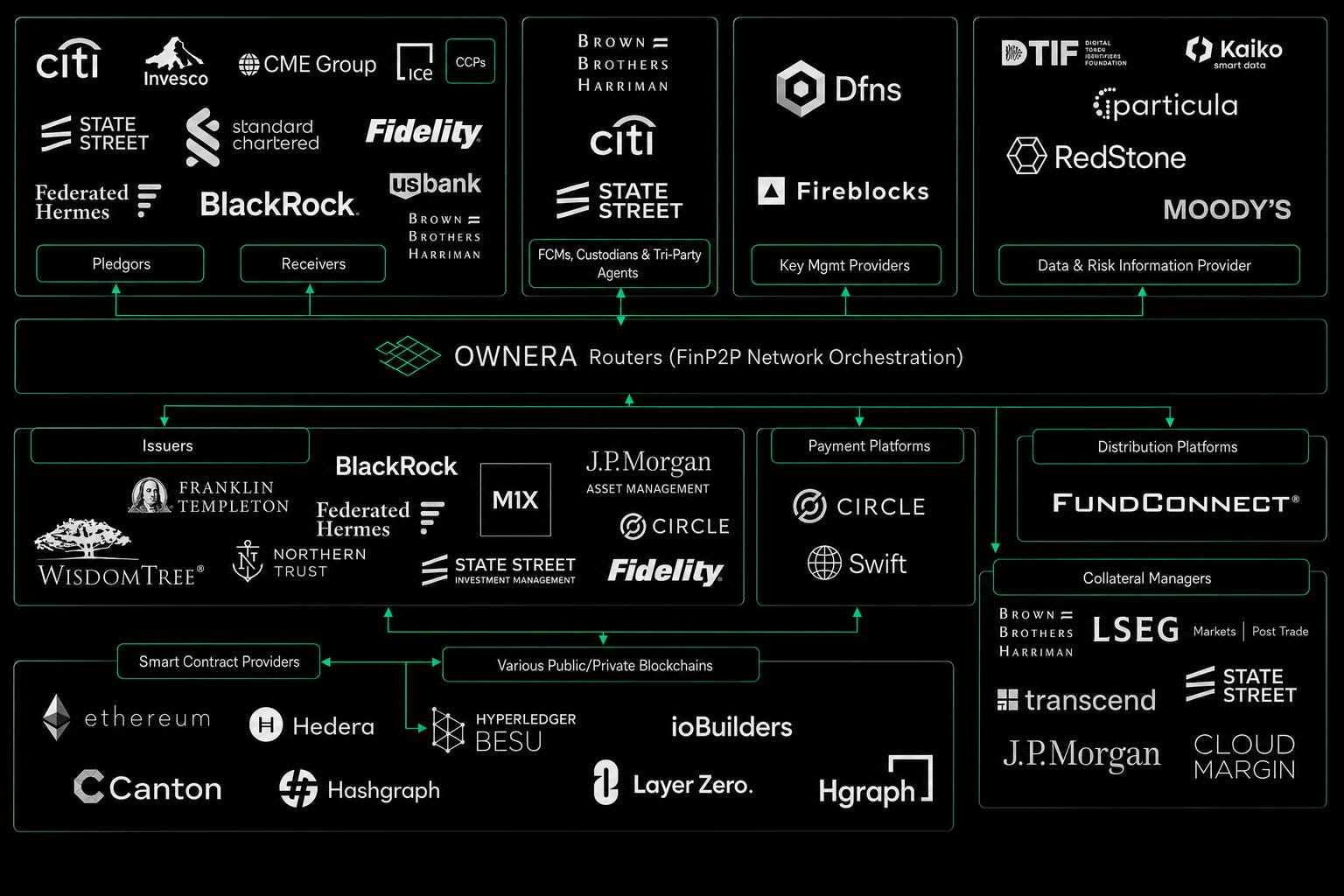
BlackRock, Citi, State Street, Fidelity, CME Group, J.P. Morgan and U.S. Bank all sat in the same live sandbox and moved tokenized collateral with settlement in minutes. Not a whitepaper. Not a someday. A working pilot, with the biggest names in finance actually pushing value across the rails. And every one of those institutions connected through the same network: Ownera.
If you’ve been following me, you probably already saw my posts about the pilot, and you know I’ve been shouting this from the mountaintops for years. Two words in particular: Collateral Mobility. The idea that the biggest institutions on earth could move collateral instantly, across firms, on shared rails, instead of it sitting stuck and idle inside siloed systems. That was going to stop being a conference-panel talking point and start being the plumbing the largest financial institutions on earth run on. Last week we got the receipt.
Global Digital Finance and ISDA published the most comprehensive industry assessment ever done on tokenized money market funds as collateral in the U.S. More than 300 participants across 120-plus firms. The live sandbox at the center of it, where those institutions settled in minutes what normally takes days, ran entirely on Ownera’s network. Every institution in that report is connecting through Ownera’s routers. And look at the report’s actual title: “Unlocking Capital with U.S. Tokenized Money Market Funds for Collateral Mobility.” The thing I’ve been telling everyone for years is now the headline of the industry’s definitive report. (Full report: https://www.gdf.io/resources/unlocking-capital-with-u-s-tokenized-money-market-funds-for-collateral-mobility/)
It’s an incredible milestone. But I don’t want to just take a victory lap on Ownera. I want to talk about how a company ends up in that room in the first place, because that’s the part most people miss.
This is what a venture studio is actually for
Most investing is reactive. You wait for the great company to already exist, then you compete with everyone else to write a check into it. By the time a deal looks obvious, you’re paying obvious-deal prices and you’re one of twenty names on the cap table.
And in the traditional world, all the diligence you do before that check is really just a glorified interview process. A few weeks of meetings, a data room, some reference calls, and you make a multi-year bet on people you’ve known for a month. Compare that to having actually worked shoulder to shoulder with the company from day one. You’ve seen how the founder handles a crisis, how they treat their team, whether they do what they say they’ll do. No amount of diligence gives you that. You’ll never have the same insights from the outside looking in.
The venture studio model flips that. You don’t wait for the winning company to find you. You build it with the founder, from the founding moment forward.
That changes everything about the relationship. You’re not a passenger who showed up at the Series B. You’re in the room from day one, when the idea is still being shaped, when the first hires are being made, when the hard early calls get decided. Sometimes you help name the thing. You help find the first customers. You help the founder survive the years when nobody else believes yet.
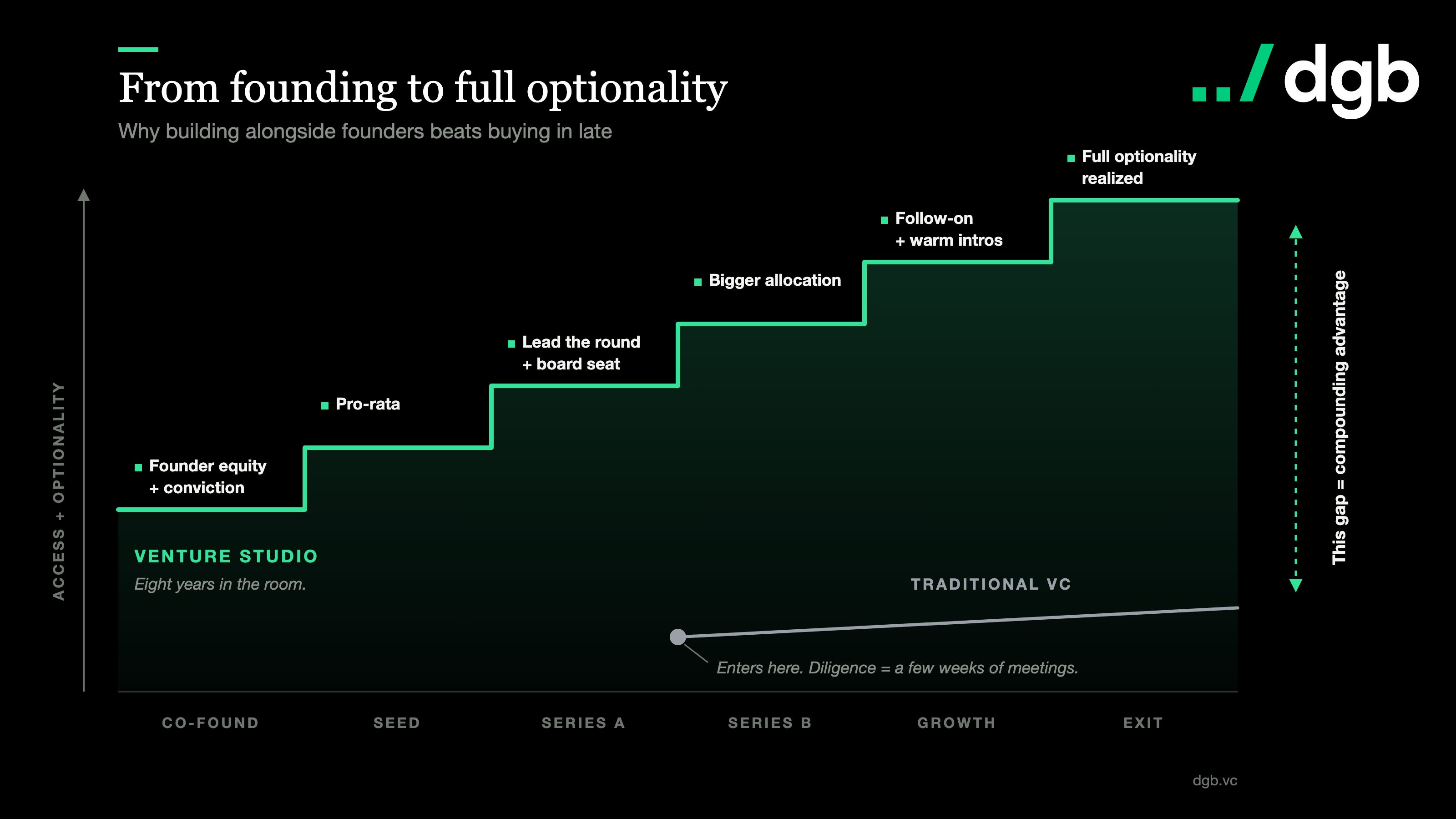
And here’s the part that compounds: that access never stops. Being there at founding earns you a seat at every opportunity that comes after. The earliest rounds. The follow-on tranches. The board seat. The intros. The partners. The team members who move on to side-quests. When the company wins, you’re not just an early investor who got lucky on entry price. You’ve been building alongside the founder the entire way, and every win the company has is a win you’re positioned for. This is the quiet reason the best early-stage funds outperform. They aren’t paying market price for information everyone already has. They’re exercising options they earned years earlier. Founding to forever.
Ownera is the proof
This one is personal for me. I didn’t just invest in Ownera. Ami Ben-David and I started experimenting together in 2018. We incubated it in our DGH venture studio. We led its Series A. I’ve held the board seat since the beginning.
None of that was an accident, and none of it was a lucky entry point I bought my way into after the fact. It’s the direct output of building alongside a world-class founder from the very first day and staying in the room ever since.
And this is the real point, because in a venture studio it is all about the founders we choose to build with. Ami Ben-David is the reason any of this happened. I have watched this man walk into rooms where the entire premise of tokenized finance was met with polite skepticism, and walk out having moved the industry an inch closer to inevitable. I have seen him through every one of those crises and opportunities I just described. The moments where the money was tight, where the market turned, where the obvious move was to compromise the vision, and every single time he found a way through. Eight years of watching someone relentlessly execute against all odds does something no data room ever could. It gives you full, unqualified trust. I would back Ami into any arena, against any competitor, in any market condition, without hesitation. Not because a pitch deck told me to, but because I have stood next to him while he earned it, over and over.
That is why, eight years later, when BlackRock and Citi and J.P. Morgan needed rails to move tokenized collateral, they were moving it through infrastructure born in our studio, built by Ami and his team. That’s not a coincidence. That’s the model working exactly the way it’s supposed to.
Because that’s the thing about infrastructure: all of it starts as somebody’s experiment. The world’s largest financial institutions are now running on one that started with two new friends asking eachother, “wouldn’t it be better if…”.
Congrats to Ami and the entire Ownera team. And if you’re a founder building at the intersection of real world assets, tokenization, and the institutions that actually move the money, this is exactly the kind of thing we love to build from day one. Come talk to me.
Proud day!
-A